


 0800 987 1087
InSight Newsletter: February 2026
InSight: February 2026
Welcome to InSight, Visibility Scotland’s twice-yearly newsletter. Our February 2026 issue features uplifting and inspiring stories involving our service users. We hope you enjoy this ‘winter warmer’ edition.
As always, an audio version of the newsletter is available at the bottom of the page.
A word from our CEO
Hello. I’m Laura Walker, honoured to be the Chief Executive of Visibility Scotland, your local and national vision impairment charity.
As an organisation, we are led by our values. These values are the bright stars that guide us, ensuring we deliver services that truly meet our communities’ needs. Our values are highlighted in bold.
We are very proud of the partnerships we have launched and strengthened during 2025. Collaboration connects services and extends reach.
The spirit of partnership was powerfully demonstrated in June, when we supported Humanitix, an accessible, non-profit ticketing platform that reinvests profits in social good, in launching here in Scotland. Humanitix shares our vision of an inclusive and accessible world where everyone can participate.
Innovation has also shaped our year. In 2025, we launched two new programmes: a stroke and vision impairment cycling training programme and a self-defence and wellbeing project. These initiatives reinforce what we know to be true, “You do not need sight to have vision”.
We have been bold and courageous in shaping the future. This year, we supported the design and launch of a brand-new postgraduate professional vision impairment rehabilitation course, transforming the professional landscape and improving access and outcomes for vision-impaired and blind people.
Our commitment to inclusivity extends well beyond our services. We continue to educate society (locally and nationally) about accessibility and the practical changes that enhance independence for people with vision impairment.
Last year, we listened, and we acted. We provided one-to-one support to more than 2,500 vision-impaired and blind people, ensuring they received personalised, meaningful help when they needed it most.
We believe our charity’s impact is life-changing. But we can only do what we do because of your support. Your trust and commitment enable us to continue our work, delivering impactful services and standing alongside you every step of the way.
On behalf of Visibility Scotland, I would like to thank you for your trust and continued support. I hope our winter newsletter shines a warm light on this year’s successes and your inspiring stories.
Service user stories
Amy’s bowling success
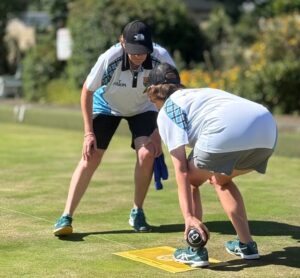
ID: Amy and her mum, Jenine, on a bowling lawn. Amy is holding a ball in a starting position whilst Jenine directs her.
When Amy Buck, a community member in Dumfries and Galloway, lost her sight at age 20, she got involved in vision-impaired bowling and quickly found her stride.
Amy travels three times per week to train and compete, with the support of her mum, Jenine, who also directs her when bowling, and has achieved several successes through her dedication and hard work.
In 2023, Amy won the Vision Impaired Bowlers Scotland area competition. In 2024, she took first place in a Bowls Scotland para test event against Ireland and came second in the Scottish Singles Championships for her classification.
This year, she’s been selected for the International Blind Bowls Association World Championships, which take place in New Zealand in 2027, and the Bowls Scotland National Championships in the Ladies Para singles.
Amy’s most recent accomplishment is being shortlisted as Dumfries and Galloway Life magazine’s Sports Person of the Year.
We’ll be cheering Amy on here at Visibility Scotland in all her future endeavours. We are in no doubt that her success to date is just the beginning.
Caroline aims to become the first DeafBlind person to summit Mount Everest
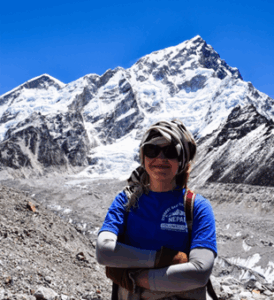
ID: Caroline at Everest base camp in May 2023. She is wearing a blue top, sunglasses, and a head wrap, as she stands smiling with Mount Everest in the background.
Caroline (Karolina) Pakenaite was born hard of hearing and, while at university, received a diagnosis of Usher Syndrome, a progressive genetic condition that causes deafblindness. Determined to make her mark, Caroline first discovered a love for mountaineering only six or so years ago, after being introduced to it by a family friend.
In May 2023, Caroline trekked to Everest base camp as part of a deaf group. By chance, she met another group of deaf climbers aiming to be the first deaf people to reach the summit. When Caroline realised no deafblind person had ever done it, she decided she would be the first.
In preparation for her attempt on Everest, Caroline has completed a marathon, an ultramarathon, the three-peaks in 24 hours challenge, and Mera Peak. Caroline recently returned home from climbing Himlung Himal in Nepal. She’s done all of this while completing her PhD in computer science, becoming Dr Caroline in autumn 2025. Caroline aims to summit Mount Everest in May 2026.
You can also hear Caroline’s story in her own words on our upcoming EyeCan podcast, which will launch this winter. She also gave a talk to some of our young people and community members.
It was inspiring to hear her resilience, determination, and passion for helping the world better understand sensory impairments. If you’d like to learn more about Caroline and follow her journey, her website is: deafblindeverestproject.com
How Thomas’s letter helped us go to GlasGLOW
In October 2025, a group of our young people attended GlasGLOW, an autumnal light show and interactive experience in Glasgow’s botanic gardens. This was thanks in no small part to the efforts of 13-year-old Thomas Wyllie.
Thomas took it upon himself to write to GlasGLOW – not for himself, but to give his fellow vision-impaired young people the opportunity to attend the event he loves. We’ve reprinted Thomas’s letter below:
“Dear GlasGLOW,
My name is Thomas Wyllie, I am 13 years old, and I have a visual impairment. I go to a charity called Visibility Scotland, where many people like me go. Sometimes blind people go too. They have cooking classes, music sessions, gaming workshops, meditation, art, and they’re going to introduce yoga.
Visibility Scotland is a local charity for kids and adults who are visually impaired or blind. You can find it around St George’s Cross. They also have family support.
Visibility Scotland is one of my favourite places to go. Everyone there is friendly, funny, and kind. They just want to have a good time. Every time I go, I forget all my worries and just have fun. Everyone that I’ve met has had a great time. They supply Domino’s Pizza before any class.
They do all this for free. No payments required, none at all. Everyone that goes will really appreciate your financial support. You would make young people feel very happy.
Yours sincerely,
Thomas Wyllie”
Following Thomas’ letter, Visibility Scotland was given GlasGLOW tickets for the young people in our EyeCan Children and Young People project, alongside invitations to the community preview night.
The young people who attended had a fantastic time exploring the exhibits and soaking up the atmosphere. Highlights included: roasting marshmallows by the fire, popping giant fog-filled bubbles, and the interactive light-up slinky tunnel.
A huge thank you from us to Thomas for his letter to Glasgow and everyone involved in this generous donation.
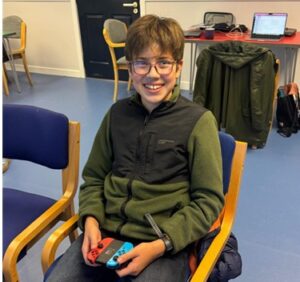
ID: A smiling Thomas sits with his Nintendo Switch controller.
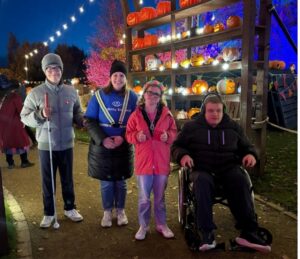
ID: Three young people with a Visibility Scotland staff member at the GlasGLOW pumpkin-themed exhibit.
Janet’s game-changing Meta Ray-Bans
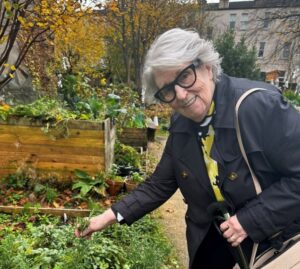
ID: Janet smiles while picking herbs and wearing her Meta Ray-Ban glasses.
Janet first heard about the new Meta Ray-Bans from her son, who had been researching technology that might support her independence.
Janet went with him to a shop to try them out. After trying the glasses, Janet knew that she wanted to purchase them as soon as possible. However, her children were frustratingly evasive whenever she asked for help going to the shop.
Eventually, Janet decided she had waited long enough and went to the shop herself. However, the staff refused to order the glasses for her, claiming they were out of stock. Janet couldn’t believe it – never in her life had she heard the like!
Janet called her daughter, angry at the treatment she’d received in the shop. It was then that her daughter came clean: she’d purchased the glasses as a present for Janet’s birthday and had roped the shop staff in on the surprise!
After a good laugh, Janet got her glasses on her birthday, and her life changed.
“I hadn’t read a book for two years because of my sight. I just couldn’t read the print at all, now I’m reading again! I have the glasses read me one page at a time, and it works brilliantly.”
Not only has Janet started reading books again, but she’s also cooking more.
With the Meta Ray-Bans, she’s able to read ingredient labels and recipes, navigate the cooker and oven settings, and make her favourite dishes again, including lasagne, soup, and steak pie.
“One of my favourite things to do is look at my bird feeder and have the glasses tell me what kinds of birds are visiting my garden”, Janet revealed. Before developing macular degeneration, she loved birdwatching at her home. Now, she’s able to enjoy it once again.
She’s also been using the glasses to help her navigate public transport through reading bus numbers, something that previously caused a number of challenges.
The next thing Janet plans to do with her glasses is take them out to a restaurant and have them read the menu to her – something she hasn’t been able to do herself in quite some time.
When asked for advice on assistive technology, Janet encouraged others considering it not to be intimidated and to give new things a try. “It’s amazing what technology can do these days; it’s really opened up my life.”
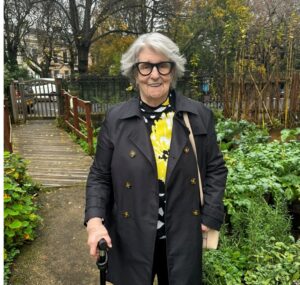
ID: Janet stands smiling in a community garden, wearing her Meta Ray-Bans.
Cycling toward independence: how our EyeCan Cycle programme empowers stroke survivors
Stroke is one of the leading causes of disability in the UK. More than half of stroke survivors experience some form of neurological visual change. One of the more common vision changes is homonymous hemianopia, where the brain ignores part of the visual field.
For someone with right-sided hemianopia, for example, anything on the right-hand side simply doesn’t exist. Everyday tasks like crossing a road or cooking a meal can suddenly become quite challenging.
For some time now, our team has been training people with visual field loss to use compensatory scanning strategies. Scanning training gives people practical techniques to increase awareness of their surroundings while walking and navigating day-to-day life.
We’ve taken things a step further by developing a unique cycling programme in collaboration with Cycling Scotland specifically for people with neurological visual field loss.
Earlier this summer, we piloted our new EyeCan Cycle programme, which enabled stroke survivors to experience cycling safely. The results were incredible.
By applying the same scanning strategies they’d learned with us to biking, participants could ride safely and rediscover an essential aspect of their independence.
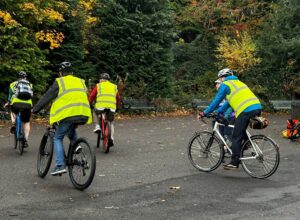
ID: Three programme participants cycle in Kelvingrove Park alongside Ali from Visibility Scotland and Nina from Cycling Scotland.
We’re now actively seeking funding and community partners to expand the programme’s reach by offering regular sessions.
By combining neuro-visual rehabilitation with cycling, we’re helping stroke survivors not only rebuild confidence, but also reconnect with their communities and rediscover independence.
As one participant put it: “I’d forgotten just how much fun biking could be – just because you’re vision impaired it doesn’t mean you can’t do it, you’ve just got to find confidence and get out there!”
If you’d like to support or learn more about the EyeCan Cycle, please visit the Visibility Scotland website or call 0800 987 1087.
How you can help
Visibility Scotland is a national charity. We support anyone living with a visual impairment across Scotland. Last year, we supported 3,016 people.
We want to do more, but we need your help!
Every donation, big or small, helps us provide our life-changing support services.
Donate today:
By phone: 0800 987 1087
Online: Visibility Scotland donate online
Or scan the QR code image below:
We’re here for you
Thank you for reading the latest issue of InSight.
If you would like to find out more about any of our services, groups, or events, then please get in touch:
Follow us on Facebook: @VisibilityScot
Follow us on Bluesky: @visibilityscotland.bsky.social
Follow us on TikTok: @visibility_scotland
Follow us on Instagram: @visibilityscotland
Email: info@visibilityscotland.org.uk
Freephone: 0800 987 1087
Audio verion of our newsletter
Please click play on the audio player below to hear our CEO, Laura Walker, narrate the newsletter.
